Showing posts with label Manchester United. Show all posts
Saturday, 14 March 2015
Are Arsenal A Good Bet For The Title?
For most of this season Arsenal have looked more like troubling the Europa League than the trophy engravers - yet after winning five on the trot, Arsene Wenger's men may just be in with a sniff of the title.
In the 3-0 win against West Ham the Gunners looked fluid and like they could destroy a robust team from any angle in a way that we haven't seen for a long time. With Walcott now fit, Welbeck, Ozil, Ramsey, Cazorla, Sanchez and Giroud all beginning to look like they might click, it's not impossible to imagine the Gunners continuing their run for a while yet.
They're now just six points behind Chelsea, albeit with the blues having two games in hand. However one of those is tomorrow against Champions League chasing Southampton, who no one has found an easy prospect all season.
They certainly look a better bet than Manchester City, whose title charge appears to have got stuck in the Lancashire hills this evening.
The Gunners also have to face Chelsea - normally as source of grief for Arsene Wenger's men, but with the blues not quite looking the side that cruised through the autumn now, with a few more wins it could take on an entirely different complexion, if Arsenal can remain in touch. Could Arsenal finally shed the hoodoo Jose Mourinho teams have had over them? If it were a dead game you'd say almost certainly not, but if the pressure were entirely on a Chelsea team that have long been penciled in as champions, it might be a different matter.
There are just enough 'competitive' fixtures for a turn round to be a possibility, as both Arsenal and Chelsea will have to face Liverpool and Manchester United teams embroiled in a brutal scrap for fourth. In addition Chelsea have to go to Loftus Road - a gimme for other teams, but sure to be a West London war if QPR can bring cheer to a misreable season by ending their hated neighbours title hopes.
Could it be a turn round akin to the great run-ins of 1997/98 and 2001/02. Almost certainly not - but at a best price of 40-1 on Oddschecker, they may well be worth a punt even if that price drops slightly, especially before Chelsea-Southampton.
Wednesday, 9 October 2013
In The Sadenning Frenzy Over The Future Of Adnan Januzaj, Only Jack Wilshere Gets Close To Talking Sense
England's latest star? Don't bank on it.
If you believe what you read
in the papers and what's babbled over the phone in-lines then Adnan Januzaj is
England's next great hope, Gazza with a few extra vowels and for whom peeing in
public is something statues do rather than Jimmy Five-bellies.
The fact that a furore seems
to have developed around an 18-year-old boy, not qualified for England, who has
played well in one Premier League game says a lot about the parlous state of
football and the utter cluelessness of those who are paid very well to sort it
out, but as well as showing weakness it shows English football’s propensity for pomposity
and disregard for anything other than the next headline, its also pretty offensive.
That's because Januzaj's
peculiar history, the very reason that poaching him is still a possibility is a
sad one that is far more important than whether we can hype ourselves up about
whether it might be our year when Januzaj might under FIFA’s rules be able to
actually play for England in 2018.
Thursday, 16 May 2013
As David Beckham Retires Should We Mourn The Passing Of A Footballing Icon Or Celebrate The End Of The Epitome Of England's Failings?
David Beckham has retired from football. To some this news will mark the end of an era, the passing of one of England’s greatest players into history, of an icon and role model who gave his all for his country.
Others, less kind or enamoured of the Leytonstone lad made good will likely quip that this news surely belongs in 2007 and that we should bid good riddance to a player who for a decade has been of more value as a billboard adornment than a right-sided midfield player.
Who’s right is not an easy question to answer; no doubt Talk Sport will devote hours of Stan Collymore , Adrian Durham and co chattering to Steve from Enfield, Gaz from Solihull and Dave from Oldham finding out.
Firstly it must be admitted that Beckham was indeed a fine footballer; you don’t get over a hundred caps for your country, win a Champions League and play for the likes of Real Madrid, Manchester United and AC Milan merely by looking good in a pair of Dolce & Gabana briefs.<!--more-->
There’s also little doubt about Beckham’s work ethic, even among professional players it stands out; he played himself back into Real Madrid and England sides that had initially cast him out through toil and sheer bloody-mindedness, played all year round while in his mid-30s, and tales of his onerous free-kick practice are legion, and have been predictably turned into advertising campaigns.
Yet there is a sense that this season’s other feted retiree was on to something when he sold Beckham to Real Madrid in 2003; that while the ‘Beckham 23’ shirts flew out of the club shop, Real’s latest Galactico was somewhat less valuable as a player on the field and certainly not in the same league as his team-mates Zinedine Zidane, Luis Figo, Ronaldo and Raul.
Under Sir Alex Ferguson at Man Utd Beckham had formed a key partnership with Gary Neville, with Neville an underrated crosser himself, overlapping and either compensating for Beckham’s weakness; the inability to beat players, or providing his team-mate with the space to indulge his famous crossing and passing ability.
Even in this team Beckham was one star among many; Ryan Giggs his predecessor as the torso wallpaper of choice for teenage girls, Roy Keane, who drove Utd to glory and the man whose retirement won’t provoke a media frenzy but probably should; Paul Scholes. That’s not to mention those in less glamourous positions like Jaap Stam or Dennis Irwin.
Certainly Beckham’s career on the field did not hit its previous heights once he left; Real only won the Spanish league title in his final season at the club, grinding past a more feted Barcelona side, while Real are still waiting for their first Champions League success since Beckham’s arrival.
It would be unfair to place the blame for this on Beckham, more it was the club’s Galactico policy of ‘Zidanes y Pavones’, of signing marquee names and pairing them with cheaper options in less glamourous areas of the field that led to an unbalanced team incapable of hitting its expected heights. Yet Beckham’s eventual role in that team may provide clues to his place in the greater scheme of things. Beckham became the Galactico Pavon, the midfield workhorse who enabled Real’s superstars to play rather than the star of the show himself.
His England career followed a similar path from glory into mediocrity; after his vilification at the 98 World Cup by 2002 Beckham was Goldenballs; the man who had led England out of their Kevin Keegan inspired dreadfulness past Germany via that free-kick against Greece into a promising if ultimately doomed World Cup campaign.
That 2002 side, with Michael Owen, who was then one of the most coveted strikers in Europe, Scholes in his pomp, the superlative defensive pairing of Sol Campbell and Rio Ferdinand before half-time flits and back injuries blunted them, came as close to any England side to winning the World Cup as any over the last 20 years, failing to beat eventual winners Brazil after the sending off of Ronaldinho.
With Scholes retiring in 2004 after becoming a victim of the Lampard-Gerard conundrum, Ferdinand’s ill-advised 2003 shopping trip and Owen’s increasing injury absences, a Wayne Rooney inspired Euro 2004 aside England went into a decline from which the so called “Golden Generation” never recovered.
Like it or not, Beckham played a major part in that decline; while Germany built a young exciting team and Spain jettisoned the likes of Raul, Morientes and Guti to enthral the world with tiki-taka, England plodded on with Beckham, Gerard and Lampard in midfield, putting faith in the idea that because these players were capable of magic moments they’d somehow gel into a team.
Instead England became dour, static and over reliant on Beckham’s crossing and dead ball ability, leading to the paradoxical situation that while Beckham would often be England’s most effective player he also epitomised the attitude that eventually would leave England looking like a pub team against Germany in the 2010 World Cup.
Was this Beckham’s fault? Probably not. Shaun Wright-Phillips’ decision to become a glorified Chelsea season ticket holder, Aaron Lennon’s lack of a brain, Theo Walcott’s slower than hoped for development and Wayne Rooney’s brainfarts meant that we soldiered on with Goldenballs while others were busy making his style of play redundant. He also can’t be held responsible for the technical deficiencies that keep England well behind other footballing heavy-weights.
In truth Beckham was an average top-level player; a man capable of holding his own in the very best teams but not the fantasy player, the inspirational genius that was required or that he was painted as after his 2001 moments of brilliance, turning in his later career into a journeyman with a marketing caravan.
Which brings us to the divide; for lovers of football who hold this fairly nuanced opinion Beckham the icon is a chimera, a false God looking resplendent on the touchline in an FA suit and the patron saint of “This is our year”, signed golden iPods and bargain bins full of footballers’ autobiographies.
One would say that David Beckham the icon is the ultimate triumph of style over substance, but there is substance to Beckham. Hours spent on the training ground perfecting those top corner curlers, a burning desire to play for his country.
It just isn’t the substance that Beckham the brand sells. If God were a football fan then Beckham would’ve been born with the face of a sanded down Iain Dowie (Dirk Kuyt for those of a more recent vintage), holding the weathered features of a grafter but slightly silkier to the touch.
If this were so, one doubts though if Beckham would’ve been worth £23m to Real Madrid, or would’ve racked up quite as many as 117 England caps, nor would he be one of the world’s richest sportsmen.
It makes it tempting to belittle Beckham’s achievements, so that when David Cameron delivers his inevitable elegy to the great man those not taken in by the Beckham myth are sorely tempted to go the other way, to pooh-pooh Beckham the footballer’s merits and not agree with those intent on placing him in the footballing pantheon.
One could be unkind and say that as with most fashion brands we’ve been sold an appearance rather than the reality, like the celebrity fashionista dressed as a punk, that there’s nothing beyond the appearance, that instead of being England’s answer to Cristiano Ronaldo, Beckham may be football’s Peaches Geldof.
This would be unfair though, as Beckham’s brilliant if not truly great career shows, there was far more to him than flogging boots, shirts and underpants. Instead the worship of Beckham the icon may be more a symptom of our treasuring of marquee names and stardom over the less feted virtues that led to Beckham’s greatest on field successes and those of other national teams who quietly moved on while we worshiped at the altar of St David.
This is fine for the likes of David Cameron, those who bought a Ramones t-shirt because D-Beck did and those lusting after his torso, but perhaps not for those who were paid millions of pounds to know better and build a team good enough to render Beckham’s limited playing style redundant.
As such it also needs to be acknowledged that while David Beckham the footballer was a great servant to England and a darn good footballer if not a great one, that he was also the prime example of English football’s golden generation’s greatest failings.
Others, less kind or enamoured of the Leytonstone lad made good will likely quip that this news surely belongs in 2007 and that we should bid good riddance to a player who for a decade has been of more value as a billboard adornment than a right-sided midfield player.
Who’s right is not an easy question to answer; no doubt Talk Sport will devote hours of Stan Collymore , Adrian Durham and co chattering to Steve from Enfield, Gaz from Solihull and Dave from Oldham finding out.
David Beckham and Gary Neville: A formidable partnership
Firstly it must be admitted that Beckham was indeed a fine footballer; you don’t get over a hundred caps for your country, win a Champions League and play for the likes of Real Madrid, Manchester United and AC Milan merely by looking good in a pair of Dolce & Gabana briefs.<!--more-->
There’s also little doubt about Beckham’s work ethic, even among professional players it stands out; he played himself back into Real Madrid and England sides that had initially cast him out through toil and sheer bloody-mindedness, played all year round while in his mid-30s, and tales of his onerous free-kick practice are legion, and have been predictably turned into advertising campaigns.
Yet there is a sense that this season’s other feted retiree was on to something when he sold Beckham to Real Madrid in 2003; that while the ‘Beckham 23’ shirts flew out of the club shop, Real’s latest Galactico was somewhat less valuable as a player on the field and certainly not in the same league as his team-mates Zinedine Zidane, Luis Figo, Ronaldo and Raul.
Under Sir Alex Ferguson at Man Utd Beckham had formed a key partnership with Gary Neville, with Neville an underrated crosser himself, overlapping and either compensating for Beckham’s weakness; the inability to beat players, or providing his team-mate with the space to indulge his famous crossing and passing ability.
Where did it all go wrong? Signing for Real Madrid in 2003
Even in this team Beckham was one star among many; Ryan Giggs his predecessor as the torso wallpaper of choice for teenage girls, Roy Keane, who drove Utd to glory and the man whose retirement won’t provoke a media frenzy but probably should; Paul Scholes. That’s not to mention those in less glamourous positions like Jaap Stam or Dennis Irwin.
Certainly Beckham’s career on the field did not hit its previous heights once he left; Real only won the Spanish league title in his final season at the club, grinding past a more feted Barcelona side, while Real are still waiting for their first Champions League success since Beckham’s arrival.
It would be unfair to place the blame for this on Beckham, more it was the club’s Galactico policy of ‘Zidanes y Pavones’, of signing marquee names and pairing them with cheaper options in less glamourous areas of the field that led to an unbalanced team incapable of hitting its expected heights. Yet Beckham’s eventual role in that team may provide clues to his place in the greater scheme of things. Beckham became the Galactico Pavon, the midfield workhorse who enabled Real’s superstars to play rather than the star of the show himself.
His England career followed a similar path from glory into mediocrity; after his vilification at the 98 World Cup by 2002 Beckham was Goldenballs; the man who had led England out of their Kevin Keegan inspired dreadfulness past Germany via that free-kick against Greece into a promising if ultimately doomed World Cup campaign.
That 2002 side, with Michael Owen, who was then one of the most coveted strikers in Europe, Scholes in his pomp, the superlative defensive pairing of Sol Campbell and Rio Ferdinand before half-time flits and back injuries blunted them, came as close to any England side to winning the World Cup as any over the last 20 years, failing to beat eventual winners Brazil after the sending off of Ronaldinho.
Beckham's greatest moment in an England shirt, against Greece in 2001
Like it or not, Beckham played a major part in that decline; while Germany built a young exciting team and Spain jettisoned the likes of Raul, Morientes and Guti to enthral the world with tiki-taka, England plodded on with Beckham, Gerard and Lampard in midfield, putting faith in the idea that because these players were capable of magic moments they’d somehow gel into a team.
Instead England became dour, static and over reliant on Beckham’s crossing and dead ball ability, leading to the paradoxical situation that while Beckham would often be England’s most effective player he also epitomised the attitude that eventually would leave England looking like a pub team against Germany in the 2010 World Cup.
Was this Beckham’s fault? Probably not. Shaun Wright-Phillips’ decision to become a glorified Chelsea season ticket holder, Aaron Lennon’s lack of a brain, Theo Walcott’s slower than hoped for development and Wayne Rooney’s brainfarts meant that we soldiered on with Goldenballs while others were busy making his style of play redundant. He also can’t be held responsible for the technical deficiencies that keep England well behind other footballing heavy-weights.
In truth Beckham was an average top-level player; a man capable of holding his own in the very best teams but not the fantasy player, the inspirational genius that was required or that he was painted as after his 2001 moments of brilliance, turning in his later career into a journeyman with a marketing caravan.
Which brings us to the divide; for lovers of football who hold this fairly nuanced opinion Beckham the icon is a chimera, a false God looking resplendent on the touchline in an FA suit and the patron saint of “This is our year”, signed golden iPods and bargain bins full of footballers’ autobiographies.
Pants, or a true great?
One would say that David Beckham the icon is the ultimate triumph of style over substance, but there is substance to Beckham. Hours spent on the training ground perfecting those top corner curlers, a burning desire to play for his country.
It just isn’t the substance that Beckham the brand sells. If God were a football fan then Beckham would’ve been born with the face of a sanded down Iain Dowie (Dirk Kuyt for those of a more recent vintage), holding the weathered features of a grafter but slightly silkier to the touch.
If this were so, one doubts though if Beckham would’ve been worth £23m to Real Madrid, or would’ve racked up quite as many as 117 England caps, nor would he be one of the world’s richest sportsmen.
It makes it tempting to belittle Beckham’s achievements, so that when David Cameron delivers his inevitable elegy to the great man those not taken in by the Beckham myth are sorely tempted to go the other way, to pooh-pooh Beckham the footballer’s merits and not agree with those intent on placing him in the footballing pantheon.
One could be unkind and say that as with most fashion brands we’ve been sold an appearance rather than the reality, like the celebrity fashionista dressed as a punk, that there’s nothing beyond the appearance, that instead of being England’s answer to Cristiano Ronaldo, Beckham may be football’s Peaches Geldof.
This would be unfair though, as Beckham’s brilliant if not truly great career shows, there was far more to him than flogging boots, shirts and underpants. Instead the worship of Beckham the icon may be more a symptom of our treasuring of marquee names and stardom over the less feted virtues that led to Beckham’s greatest on field successes and those of other national teams who quietly moved on while we worshiped at the altar of St David.
This is fine for the likes of David Cameron, those who bought a Ramones t-shirt because D-Beck did and those lusting after his torso, but perhaps not for those who were paid millions of pounds to know better and build a team good enough to render Beckham’s limited playing style redundant.
As such it also needs to be acknowledged that while David Beckham the footballer was a great servant to England and a darn good footballer if not a great one, that he was also the prime example of English football’s golden generation’s greatest failings.
Wednesday, 8 May 2013
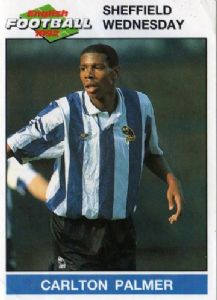
Wikipedia's Exclusive: Carlton Palmer Set To Take Over From Sir Alex Ferguson At Man United?
Most of the footballing world seems to think that David Moyes is set to take over from Sir Alex Ferguson upon his retirement from management.
However if Wikipedia is to be believed this evening the Scot is only set to get the job because a more absurdly legged man turned the job down to spend more time with his betting company:
As someone who's witnessed Carlton's heroic feats in the flesh, all I can say is that the Stretford End should be weeping salt tears that they won't get to sing about Carlton's alleged predilection for a toke on the funny fags, nor his proportionately tiny head next season.
On second thoughts, maybe it's the hilarious web-japeseters who've had too much of Carlton's rumoured herbal remedy of choice.
Sir Alex Ferguson's Greatest Achievement Is One Even Manchester United Fans Should View With Regret
In the end its unpredictability was strangely predictable –
after the farrago around his previous attempt to retire in 2002 Sir Alex
Ferguson was never going to announce his retirement in advance.
Yet the announcement in some ways still comes as a shock;
the end of an era, to use a phrase that will adorn social media networks and
lazy hagiographies.
Despite his unprecedented success in the game, with only the
combined total of Liverpool’s boot room boys competing as far as honours are
concerned, Ferguson still is a polarising figure and one whose achievements
have been difficult to love.
Labels:
1993,
1999,
Abramovic,
Barcelona,
Beckham,
Cantona,
David Moyes,
Football,
Giggs,
Jose Mourinho,
Man Utd,
Manchester United,
Premier League,
Ronaldo,
Rooney,
Scholes,
Sheffield Wednesday,
Sir Alex Ferguson
Subscribe to:
Posts (Atom)